Unique Things to Do in Napa Valley Beyond Wine Tasting
Napa Valley has a full day’s worth of things to do that have nothing to do with a tasting room. You can be airborne over the vineyards at sunrise, walking under redwoods by mid-morning, and soaking in a mineral pool by afternoon. We have been farming here on Orchard Avenue since 2000, and the trips guests describe most fondly at our table are almost never the ones spent entirely in tasting rooms.
Here is what we would actually send you to do.
What is there to do in Napa Valley besides wine tasting?
More than most visitors expect. The valley runs about 30 miles from the town of Napa up to Calistoga, and each town along that stretch does something different.
Downtown Napa holds the food and the walkable things. Yountville is small, tidy, and dense with restaurants. St. Helena has the culinary school and the best main street shopping. Calistoga is geothermal, so mineral pools, mud baths, and a geyser that was erupting long before anyone planted Cabernet up there.
Pick one or two of those, not all four. The driving is what ruins otherwise good days here.
What is the best early morning activity in Napa Valley?
A hot air balloon at sunrise. It is the one activity in the valley that guests consistently tell us was worth the money.
Flights launch out of the Yountville area, and check-in is early, usually somewhere around 5:30 or 6am depending on the season. You are in the air for roughly an hour while the sun comes up over the Vaca Mountains. You are back on the ground with breakfast in front of you before most tasting rooms have unlocked their doors. Napa Valley Aloft launches from Yountville itself, and Balloons Above the Valley flies daily in season as well.
Book it for your first morning rather than your last. Flights get grounded for wind and fog, and a spare day means you can rebook instead of losing the deposit.
Planning a visit? Reserve a tasting at O'Brien Estate →
Where can you hike or get outdoors in Napa Valley?
There is real hiking here, and almost nobody visiting does it.
Skyline Wilderness Park sits just outside downtown Napa with more than 25 miles of trails and a lake at the eastern end. Bothe-Napa Valley State Park near St. Helena has redwoods, which surprises people who picture Napa as nothing but vines and grass. The Oat Hill Mine Trail out of Calistoga is a harder climb, and wagon ruts from the 1890s are still cut into the rock.
For something flatter, the Napa Valley Vine Trail is a paved path you can walk or ride between south Napa and Yountville. Rent a bike downtown and you have a half day without touching the car.
Kayaking the Napa River from downtown is the quiet option. The water is glass in the morning, and you paddle past herons and old brick warehouses instead of vineyards.
What should you do on a rainy or cold day in Napa Valley?
Go indoors to the art and the food. Winter here does not shut the valley down, it moves it inside.
The di Rosa Center for Contemporary Art in Carneros holds more than 1,600 works by Northern California artists across two galleries, a sculpture meadow, and a lake, all on 217 acres ten minutes from downtown. Hess Persson Estates on Mount Veeder keeps a serious contemporary collection on site, so you get a gallery and a winery in one stop.
Downtown, the CIA at Copia runs cooking demonstrations and classes. Up in St. Helena, the Culinary Institute’s Greystone campus occupies an 1889 stone building that started life as a winery.
For the other kind of indoor afternoon, Calistoga’s mineral pools and mud baths have been running for more than a century. Indian Springs and Dr. Wilkinson’s are the two names people know. Book the treatment ahead.
Winter is also when the valley is at its quietest, which is the argument for coming then. Our own hours narrow from November through April, Wednesday to Sunday, and those months are the easiest time to get an afternoon at our table without booking weeks out.
What are the most unusual things to do in Napa Valley?
The strangest ones cluster up near Calistoga.
Old Faithful Geyser of California is one of three geysers in the world carrying that name, and it erupts every 10 to 45 minutes depending on rainfall and the season. There are fainting goats on the property too. The Petrified Forest a few miles west holds redwoods flattened and buried by a volcanic eruption roughly three million years ago. Neither is polished. Both stay with you longer than the fifth tasting room of the trip.
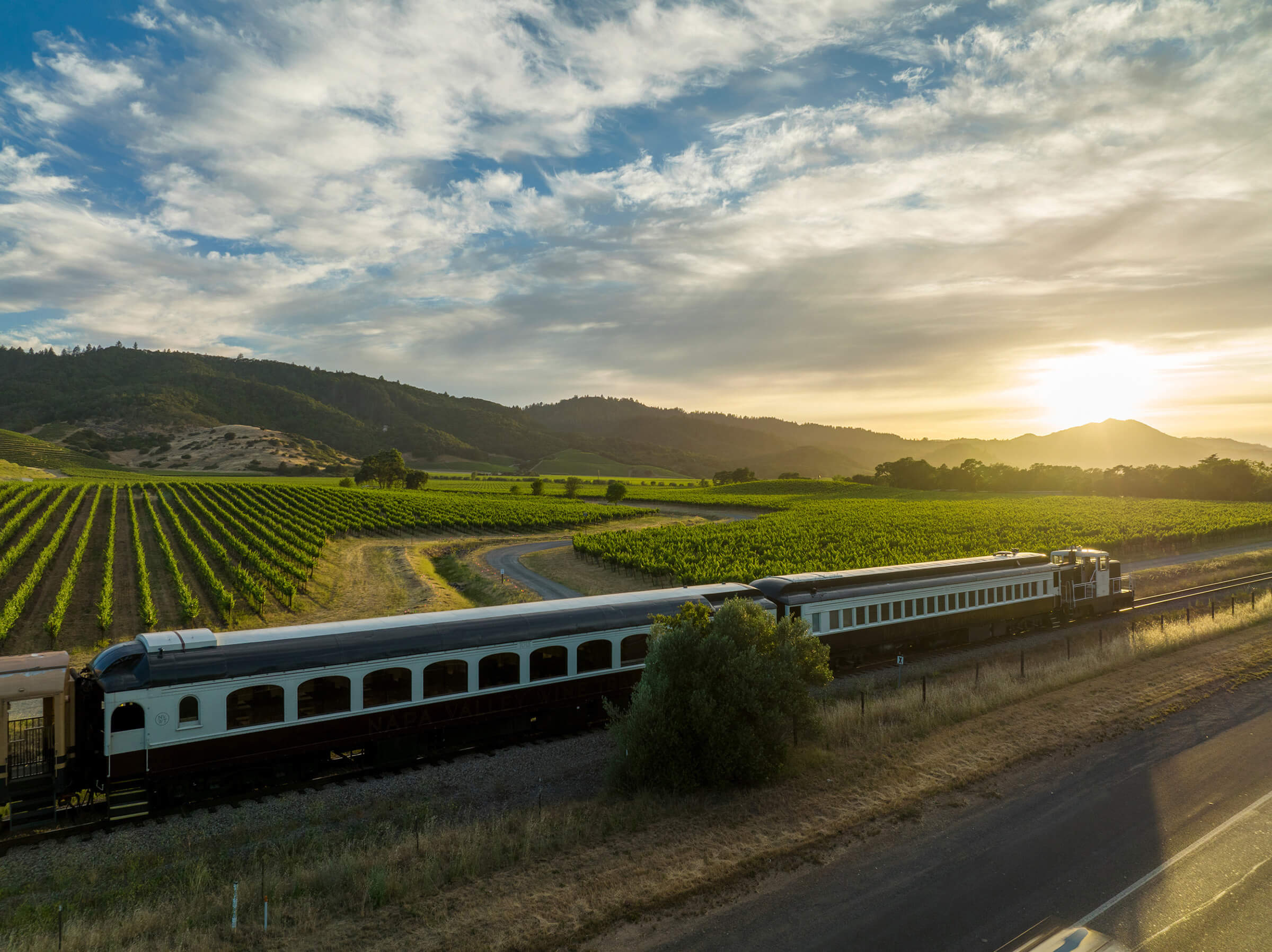
The Napa Valley Wine Train leaves downtown Napa in restored 1915 Pullman cars and runs a 36 mile round trip up to St. Helena with a multi-course meal on board. It is touristy and expensive. It is also the only way to see the valley from a dining car.
Oxbow Public Market in downtown Napa is the low-effort option that never disappoints. Oysters, bread, coffee, cheese, all under one roof, open late enough to work as dinner.
How do you fit non-wine activities around a tasting?
Put the activity in the morning and the tasting in the afternoon. Most of the good outdoor things here happen at dawn, and most wineries save their best appointments for after lunch.
A day that works: balloon at sunrise, breakfast in Yountville, a short walk to shake off the early start, lunch around noon, then one seated tasting at 2 or 3pm. You finish the day sitting down with a glass instead of sprinting to a fourth appointment.
The one thing we would not cut is the tasting itself. Make it one good one. Our guide to the best wineries in Napa Valley sorts them by the kind of afternoon each one gives you, and our guide to choosing a Napa winery experience covers what to ask before you book anything.
Where does a private tasting fit into a day like this?
At the end of it, when you are tired and want to sit down. That is exactly the visit most Napa wineries are not built for.
Most of them put you at a shared bar or move you through the property with a group on a fixed clock, which is a hard place to land after you have been awake since five. At O’Brien Estate there is no bar and no group. You get a private table looking out over the vineyard, your own host, and whatever pace the two of you want. Bart and Barb usually meet guests at the door themselves.
We are ten minutes north of downtown Napa in the Oak Knoll District, which makes us easy to pair with a morning anywhere in the southern half of the valley. Everything poured comes off the 33 acres in front of you. The wines are named for lines of poetry Bart wrote for Barb, which is a longer story than a blog post can hold, and one he will tell you if you ask.
Tastings run $85 a guest for the Private Tasting and $150 for the Reserve. Both are by reservation only, and neither is shared with another party.
If you want the wine side of the itinerary too, our complete guide to things to do in Napa Valley covers it alongside everything above. Coming up from the city for the day? Start with our Napa wine tours from San Francisco guide instead, because the drive is longer than the map suggests.
Reserve your tasting, then build the rest of the day around it.
Frequently asked questions
What is there to do in Napa Valley for non-drinkers?
Plenty. Hot air ballooning, hiking at Skyline or Bothe-Napa Valley State Park, the di Rosa art center, Oxbow Public Market, cooking classes at the CIA, mineral pools in Calistoga, and kayaking the Napa River all stand on their own without a glass involved.
Is Napa Valley worth visiting if you do not like wine?
Yes, if you like food, landscape, and quiet. The dining alone justifies the trip, and the valley is one of the prettiest drives in California.
What is the best free thing to do in Napa Valley?
Hiking and the Vine Trail. Both cost nothing beyond parking, and the Vine Trail gets you between towns without a car.
How many days do you need in Napa Valley?
Two full days covers the highlights without rushing. Three lets you add a balloon flight or a day up in Calistoga and still keep an unhurried afternoon.